Music journalism, books and more
The Legend Lives On – Lightfoot's “Wreck of the Edmund Fitzgerald”

On a blustery night in November 1975, Gordon Lightfoot was sitting in his writing room on the third floor of his Beaumont Road house in Toronto’s Rosedale neighbourhood, working on songs for his next album. Needing more fuel for the task, he headed downstairs to his kitchen for coffee. A report on the 11 p.m. CBC news told him of the sinking of a giant freighter, the SS Edmund Fitzgerald, in a fierce storm and the loss of all 29 men aboard. “I remember it so well,” Lightfoot told biographer Nicholas Jennings. “The wind was howling even in Toronto that night, and I went back up to the attic thinking, ‘I wonder what it’s like up on Lake Superior. It must’ve been awful. I didn’t think about it again for another week, but I already had a melody, like the drone of an old Irish chantey. No story, just the chords.”
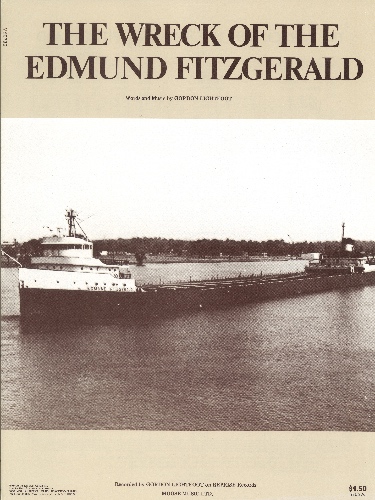 Lightfoot came up with the lyrics after finding an article titled “The Cruelest Month” in the November 24th issue of Newsweek magazine. He read the opening line and was instantly captivated: “According to the legend of the Chippewa tribe, the lake they once called Gitche Gumee ‘never gives up her dead.’” As he’d done with “Canadian Railroad Trilogy” and other factually based songs, Lightfoot set about thoroughly researching his subject, taking a documentarian’s approach to the task, detailing the ship’s 26,000-ton load, the hellish winds and monstrous waves and the fate of captain and crew—even recounting how the church bell in Detroit’s “Maritime Sailors’ Cathedral” “chimed til it rang twenty-nine times for each man.”
At the time of the shipwreck, Lightfoot owned a sailboat that he took on trips around Georgian Bay and was well aware of the dangers of the Great Lakes’ turbulent waters. As a sailor himself, he could certainly imagine the havoc brought on by a giant rogue wave on Lake Superior. Lightfoot had been fascinated by ships his whole life; he witnessed one being launched in Orillia, on the shores of Lake Couchiching, when he was just seven years old and was awestruck as it slid sideways into the water and created a huge, powerful wave. Lightfoot’s interest in ships and shipwrecks grew deeper over the years. For him, there was something mystical about a sinking ship that touched him deeply.
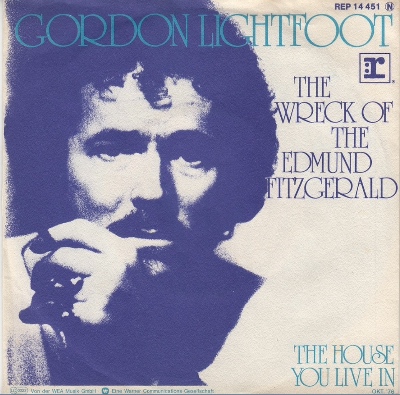 When Lightfoot finished composing and recording his song about the Edmund Fitzgerald, few expected it to become a hit. For one thing, it had no chorus. For another, it was six minutes long. Hardly radio friendly. And yet, as soon as it started getting played by deejays, the song—with its detailed description of the ship and its crew’s horrific fate—struck a nerve with a wide range of listeners.
By November 9, 1976—almost a year to the day from when Lightfoot first heard about the ship going down—“The Wreck” hit number 1 on Canada’s RPM charts and number 1 and number 2 on the US Cashbox and Billboard charts respectively, making it Lightfoot’s most successful single after “Sundown.” As critic Ann Powers in the New York Times wrote, it was “perhaps the only sea chantey to become a major hit in the arena rock era.” The song went on to be nominated for two Grammy awards the following year and has since been covered by numerous artists, ranging from Canada’s Rheostatics and Headstones to Irish legend Christy Moore and U.S. bluegrass artist Billy Strings and the band the Punch Brothers.
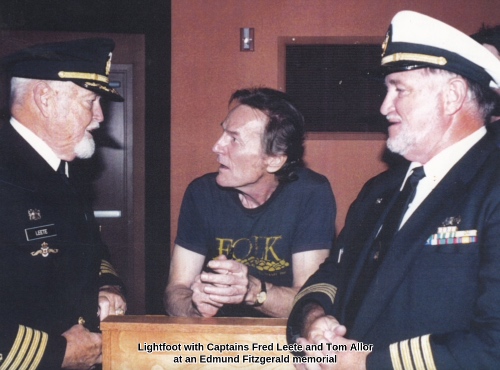 Most importantly for Lightfoot, who up until his death in 2023 maintained a close connection with the ship’s victims’ families and took part in many remembrances on the anniversaries of the sinking, the song has helped to preserve the memory of those lost that night. “I just can’t walk away from it,” Lightfoot once said. “That was one of the songs that kept my career going.” And paying his ongoing respects to the men of the Edmund Fitzgerald was Lightfoot’s way of giving back.
Click to hear “The Wreck of the Edmund Fitzgerald”
Adapted from Lightfoot, the bestselling biography of Gordon Lightfoot by Nicholas Jennings.